The architectureDetection through intercept

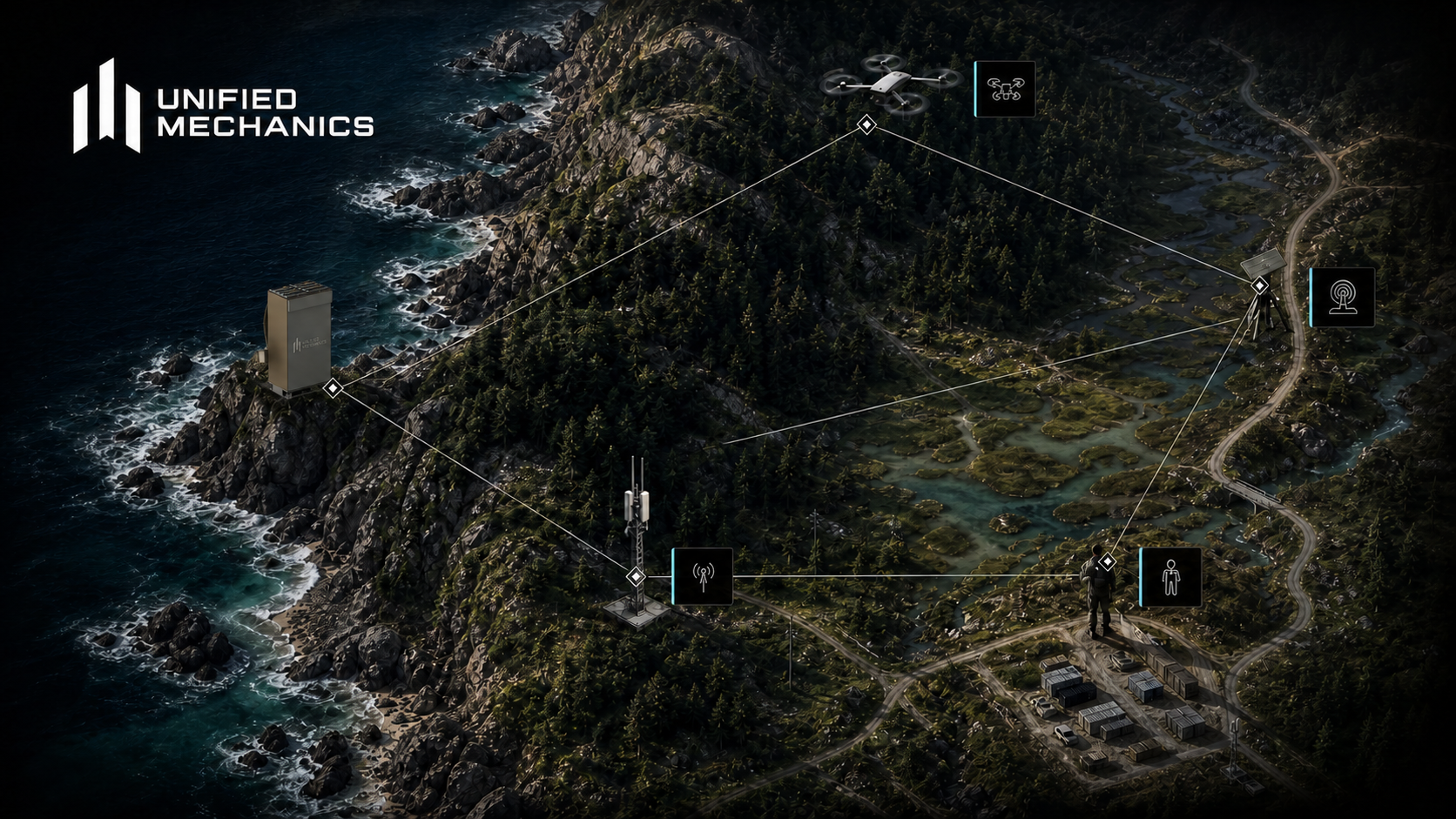
One mission. Five systems. No orphaned interfaces.

Unified Mechanics connects field sensing, radar, command and control, protected launch, and autonomous interception under one technical baseline.

Looping mission view

Watch the architecture move as a system.

A conceptual public visualization of the mission sequence. Configuration geometry and performance detail remain controlled.

01

HEED

02

MOUND

03

COMPOSITION

04

TANKARD

05

THORNWALL

Mission sequence

Every layer has a job. Every handoff has an owner.

01

Radar

HEED

The sensing and track-generation layer.

HEED detects and tracks airborne threats, then supplies actionable track data to COMPOSITION. It is designed to operate as a standalone radar or as the sensing package within a larger Unified Mechanics deployment.

System detail
02

Sensor Node

MOUND

The field layer that hosts, connects, and processes.

MOUND is a deployable node for power, communications, edge compute, enclosure, mast, and sensor interfaces. It can host HEED, another sensor package, or operate as a communications and processing node within a distributed network.

System detail
03

Command + Control

COMPOSITION

The mission coordination and control layer.

COMPOSITION turns sensor data into a common operating picture, connects operators with distributed systems, and coordinates the path from track formation to interceptor launch and mission oversight.

System detail
04

Protected Launch

TANKARD

A distributed canister built to protect, position, and launch.

TANKARD provides a field-deployable launch architecture for protected interceptors. The current inert demonstrator is validating mechanical packaging, avionics integration, deployment, serviceability, and system interfaces.

System detail
05

Autonomous Interceptor

THORNWALL

The autonomous UAV that completes the mission.

THORNWALL is an autonomous counter-UAS interceptor designed to receive the mission, launch from TANKARD, and close the terminal engagement through onboard guidance and a proximity blast-fragmentation defeat mechanism.

System detail

The engineering program

Architecture becomes real through disciplined ownership.

Hardware, software, and operational integration advance against the same requirements and interface definitions. Problems are found at the layer where they begin, not after they migrate into a full-system test.

Current beachhead

TANKARD inert demonstrator

The demonstrator is the first physical integration point for mechanical packaging, avionics, deployment, serviceability, and the interfaces that connect the broader system.

01

Mechanical systems

Packaging, structures, deployment mechanisms, serviceability, and physical integration are designed around field use from the beginning.

02

Avionics + RF

Power, communications, sensing, embedded compute, and vehicle electronics mature against the same interface assumptions.

03

Mission software

Data fusion, operator workflows, guidance, command and control, and autonomy are built as a connected software mission layer.

04

Test + validation

Bench, subsystem, integration, and field testing retire risk before the complete architecture is exercised as a mission system.

Development cycle

Build evidence into every phase.

01

Requirements

Define what the mission demands and what the operator must be able to trust.

02

Interfaces

Control the physical, electrical, data, safety, and command boundaries between systems.

03

Prototype

Build the smallest physical proof that can expose incorrect assumptions.

04

Integrate

Exercise the handoffs where otherwise capable components become one architecture.

05

Validate

Measure performance, reliability, failure behavior, and operational utility.

Architecture rules

Independent value

Each system has a defined role and can create value as a standalone product or integration layer.

Deliberate interfaces

Power, data, timing, command authority, safety, and maintenance boundaries are engineered instead of inherited.

One accountable baseline

The complete mission arc is governed by one architecture and one team responsible for how the handoffs perform.

Discuss the architecture through a controlled briefing.