Unified MechanicsLayered air defense. At soldier scale.

A distributed defense architecture that enables soldiers and small units to detect, coordinate, and defeat airborne threats: from first track to autonomous intercept.
Explore the architecture

We build the systems that move a defense mission from detection to intercept.

Integrated Defense / Mission Systems

The operating principle

The chain is only as strong as the handoffs between its systems.

01

The threat moves as a system

Low-cost unmanned threats compress decision time and force sensors, operators, networks, and effectors to act as one.

02

Integration decides the outcome

A capable component is not enough. Track quality, communications, command logic, launch readiness, and terminal guidance must survive every handoff.

03

One team owns the chain

Unified Mechanics engineers the interfaces between systems instead of leaving mission performance to a collection of disconnected vendors.

05

Mission systems

01

Integrated architecture

01

Accountable team

Five products. Engineered as one defense system.

Unified Mechanics owns the interfaces from first track to final intercept. Each product stands on its own. Together, they form a complete counter-UAS architecture with one technical baseline and one team accountable for performance.

SENSE + CONNECT

Build the operating picture

HEED develops the track. MOUND extends power, communications, sensing, and edge processing across the defended area.

DECIDE + COORDINATE

Turn data into action

COMPOSITION unifies sensor inputs, operator control, and effector coordination into one mission layer.

LAUNCH + INTERCEPT

Close the engagement

TANKARD protects and launches the effector. THORNWALL autonomously closes the final intercept.

Explore the complete architecture
[ Systems ]

Five systems. One integrated architecture.

HEED detects. MOUND connects. COMPOSITION coordinates. TANKARD launches. THORNWALL intercepts.

01[ Radar ]

HEED

The sensing and track-generation layer.

HEED detects and tracks airborne threats, then supplies actionable track data to COMPOSITION. It is designed to operate as a standalone radar or as the sensing package within a larger Unified Mechanics deployment.

View system
02[ Sensor Node ]

MOUND

The field layer that hosts, connects, and processes.

MOUND is a deployable node for power, communications, edge compute, enclosure, mast, and sensor interfaces. It can host HEED, another sensor package, or operate as a communications and processing node within a distributed network.

View system
03[ Command + Control ]

COMPOSITION

The mission coordination and control layer.

COMPOSITION turns sensor data into a common operating picture, connects operators with distributed systems, and coordinates the path from track formation to interceptor launch and mission oversight.

View system
04[ Protected Launch ]

TANKARD

A distributed canister built to protect, position, and launch.

TANKARD provides a field-deployable launch architecture for protected interceptors. The current inert demonstrator is validating mechanical packaging, avionics integration, deployment, serviceability, and system interfaces.

View system
05[ Autonomous Interceptor ]

THORNWALL

The autonomous UAV that completes the mission.

THORNWALL is an autonomous counter-UAS interceptor designed to receive the mission, launch from TANKARD, and close the terminal engagement through onboard guidance and a proximity blast-fragmentation defeat mechanism.

View system

Products with independent value. Greater force when connected.

Our portfolio spans the physical and digital layers of counter-UAS defense. Public detail is intentionally limited while engineering validation and intellectual-property review continue.

01

Radar

HEED

The sensing and track-generation layer.

HEED detects and tracks airborne threats, then supplies actionable track data to COMPOSITION. It is designed to operate as a standalone radar or as the sensing package within a larger Unified Mechanics deployment.

Detection + trackingTrack generationC2 integrationStandalone deployment
View system
Controlled public release

Not shown
by design.

Detailed sensor imaging, RF architecture, integration interfaces, detection performance, and deployment geometry are withheld from public release.

Current phase / Development configuration
02

Sensor Node

MOUND

The field layer that hosts, connects, and processes.

MOUND is a deployable node for power, communications, edge compute, enclosure, mast, and sensor interfaces. It can host HEED, another sensor package, or operate as a communications and processing node within a distributed network.

Field powerTactical communicationsEdge computeModular sensor interfaces
View system
Controlled public release

Not shown
by design.

Detailed enclosure, antenna, power, network, sensor-interface, and deployment configurations are withheld from public release.

Current phase / Development configuration

03

Command + Control

COMPOSITION

The mission coordination and control layer.

COMPOSITION turns sensor data into a common operating picture, connects operators with distributed systems, and coordinates the path from track formation to interceptor launch and mission oversight.

Sensor fusionTrack managementOperator controlEffector coordination
View system
Controlled public release

Not shown
by design.

Operator interfaces, software architecture, data models, autonomy logic, and implementation details are withheld from public release.

Current phase / Active software development

04

Protected Launch

TANKARD

A distributed canister built to protect, position, and launch.

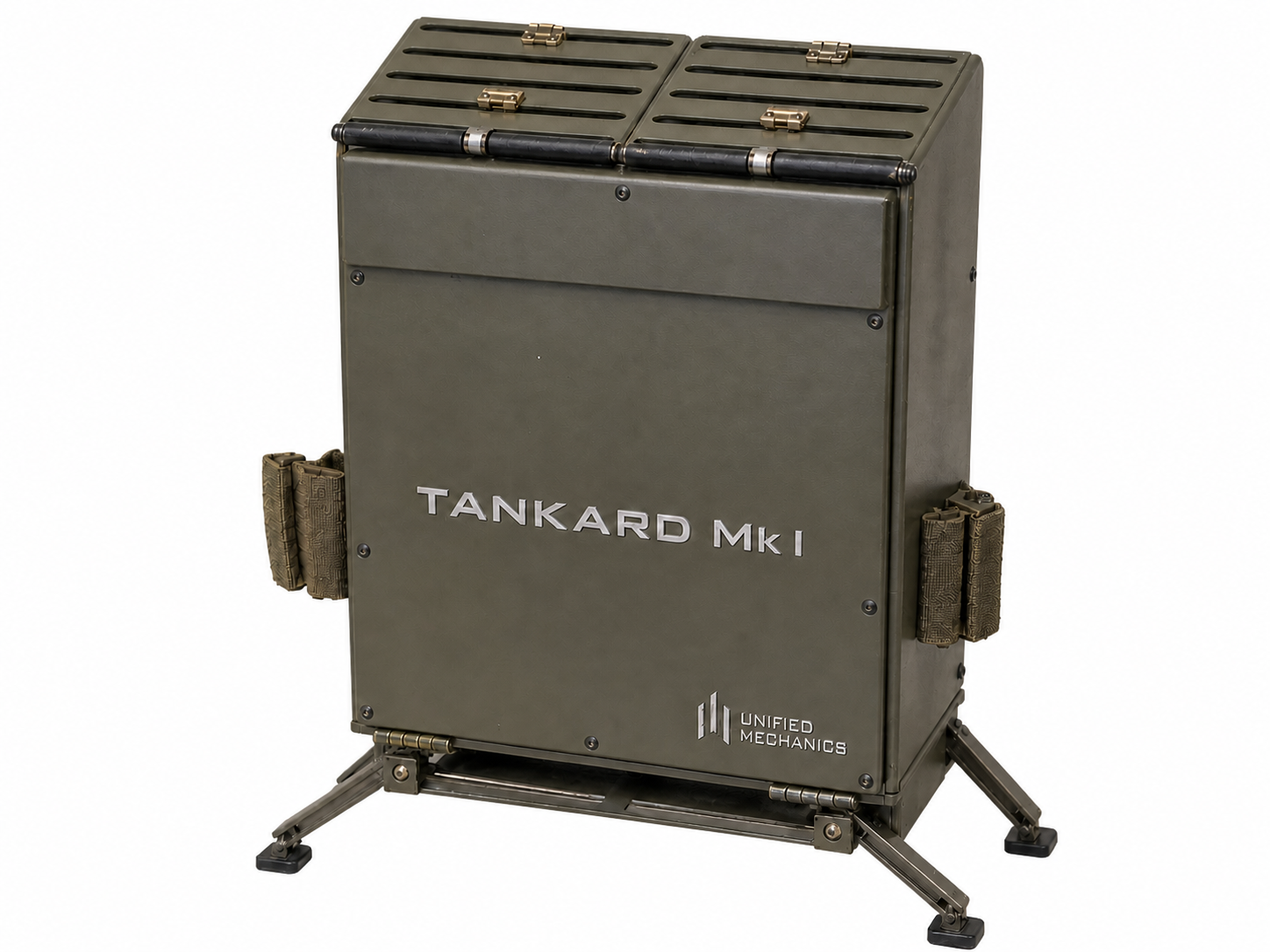
TANKARD provides a field-deployable launch architecture for protected interceptors. The current inert demonstrator is validating mechanical packaging, avionics integration, deployment, serviceability, and system interfaces.

Protected carriageDistributed positioningIntegrated avionicsRapid field setup
View system
TANKARD inert demonstrator

Current phase / Inert demonstrator

05

Autonomous Interceptor

THORNWALL

The autonomous UAV that completes the mission.

THORNWALL is an autonomous counter-UAS interceptor designed to receive the mission, launch from TANKARD, and close the terminal engagement through onboard guidance and a proximity blast-fragmentation defeat mechanism.

Autonomous UAVOnboard guidanceTerminal interceptionProximity-effect engagement
View system
Controlled public release

Not shown
by design.

Airframe geometry, propulsion, guidance implementation, seeker configuration, performance, and terminal-effect details are withheld from public release.

Current phase / Development configuration

Built for different missions. Connected by the same architecture.

Unified Mechanics products can deploy together or integrate into a broader defense network. The operating environment determines the configuration; the interfaces remain deliberate.

Fixed-Site Defense

An integrated sensing, command, launch, and intercept architecture for protecting critical locations against unmanned aerial threats.

Expeditionary Operations

Deployable nodes and distributed launch systems designed for teams that must establish a defensive picture and reposition quickly.

Distributed Protection

Networked sensors and effectors that extend coverage without concentrating the complete defense architecture in one location.

System Integration

Products with defined interfaces for primes, government teams, and partners that need a sensing, C2, launch, or intercept layer inside a larger system.

Build the next layer with us.

Unified Mechanics works with mission partners, engineers, manufacturers, and investors who understand that consequential defense systems are built through disciplined iteration.

Government + Mission Partners

Requirements, operational needs, demonstrations, and integration.

Engineering + Industry

Technical partnerships, manufacturing, suppliers, and testing.

Investors

The Unified Mechanics pre-seed round and the company we intend to build.

contact@unifiedmechanics.ai